Tokopedia Affiliate
Mar 19, 2024
Tokopedia Affiliate
Mar 19, 2024
Tokopedia Affiliate
Mar 19, 2024
Scope: Design from scratch, Competitive research, Ideation workshop, Design, Validation.
Role: Senior Product Designer
Background
There are approximately 160 million social media users across platforms in Indonesia (59% penetration according to the Global Web Index); they spend 3 hours a day scrolling through Instagram, Facebook, TikTok and Youtube. The adoption of social media led to the birth of not just passive viewers, but also content creators. They share their slice of life, point of view on current events, and also various experiences and recommendations, making social media as one of the most influential channels to form opinions and nudge decision-making. Some content creators are successful in gathering followers and monetizing their audience, whilst the remaining 95% are still struggling to establish themselves in the market.
This becomes an opportunity to increase Tokopedia’s share of voice on social media by creating a platform enabling content creators to promote millions of products on Tokopedia and monetize their influence in their circle.
Previously Tokopedia had already launched a similar product that we called By.me, but the performance was not good enough to maintain. So. we planned to change the concept of the product so that can be more useful for our users and gain traffic to Tokopedia.
Objective
Enable affiliates to promote Tokopedia Power Merchant & Official Store products with generated Tokopedia affiliate links placement in their content and monetize any successful traffic orders that come to Tokopedia from their affiliate link.
Success metrics
The main success metric of this product is the Increasing number of product visitors (traffic) to the product detail page from the affiliate link shared by the affiliate.
Our Target Users
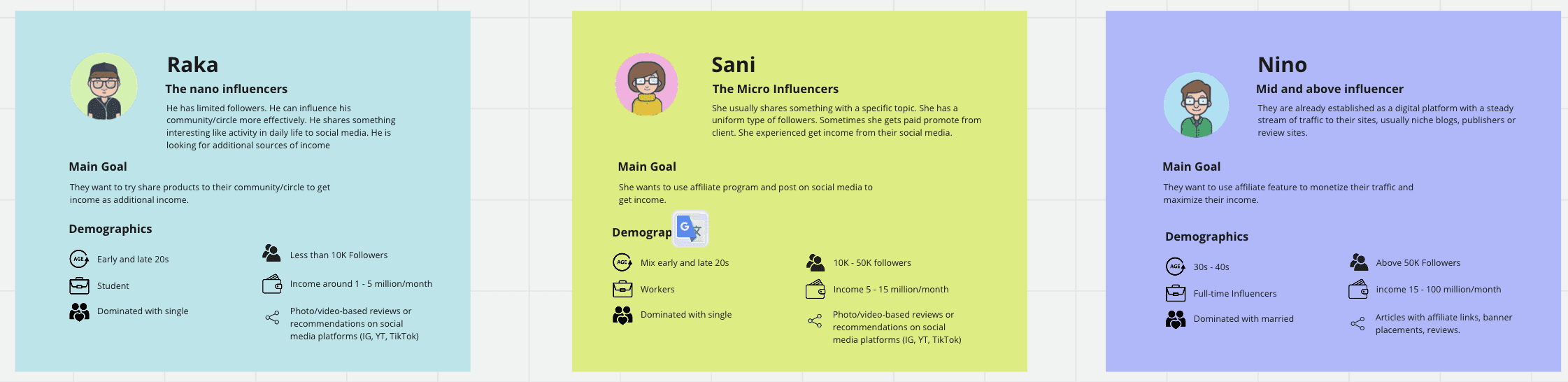
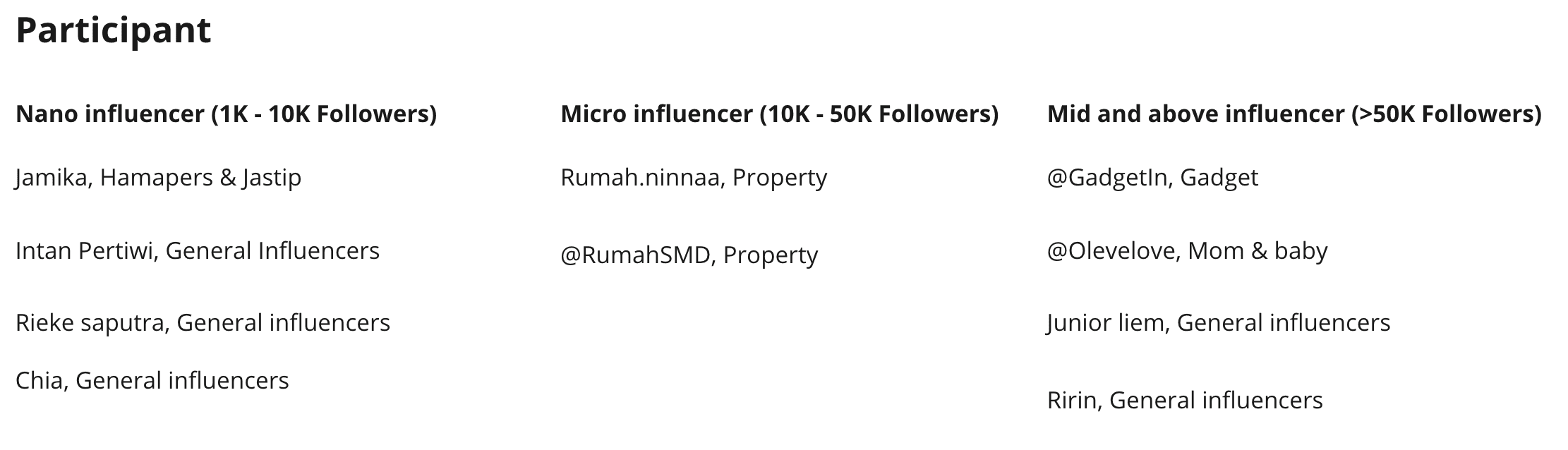
We target people who want to monetize their traffic on social media and their influence power on their surrounding environment. We categorized it into 3 segments (Nano influencers, Micro influencers, Mid and above influencers):
Revisit Old Product Concept and Look at the new one
Effective in Q2 2021, we started to revisit our product, because previously we had already launched a similar product that we called By.me, but the performance was not good enough to maintain. Let’s see the main differences between the old and the new concepts below:
What is the difference between By.me and Affiliate Program?
By.me
While everyone could be an affiliate, users can only recommend products that opt-in merchants had selected and set commission. Merchant adoption became a bottleneck for overall product adoption.
Limited number of products (Supply constraint).
By.me content is only discoverable on users’ profiles in the Tokopedia app. Not available on other platforms, I have to know someone’s By.me ID to find the landing page.
Limited adoption. Post is mostly PDP images with captions from the user.
Tokopedia Affiliate
Hassle-free for the Seller to use the general commission table which applies to Products with PM & OS badges automatically eligible to be promoted
Have access to millions of products PM & OS to promote.
Affiliate-generated links can be used on widely accessible public media, such as social media (YouTube, Facebook, Instagram, Twitter, TikTok)
Multiple content formats and properties that allow different types of landing pages (PDP, SRP, CLP, Catalog or Discovery pages) thus make it easier for content creators to link products in a more granular manner.
After we had the same vision and clear concept to re-create this product, I as a designer started to do my design process.
Competitive and qualitative research
Competitive research
I did my competitive research to be more understand specifically the experience and the design of competitors. I did competitive research on several platforms including:
Amazon
Shopee
Lazada
Involve Asia
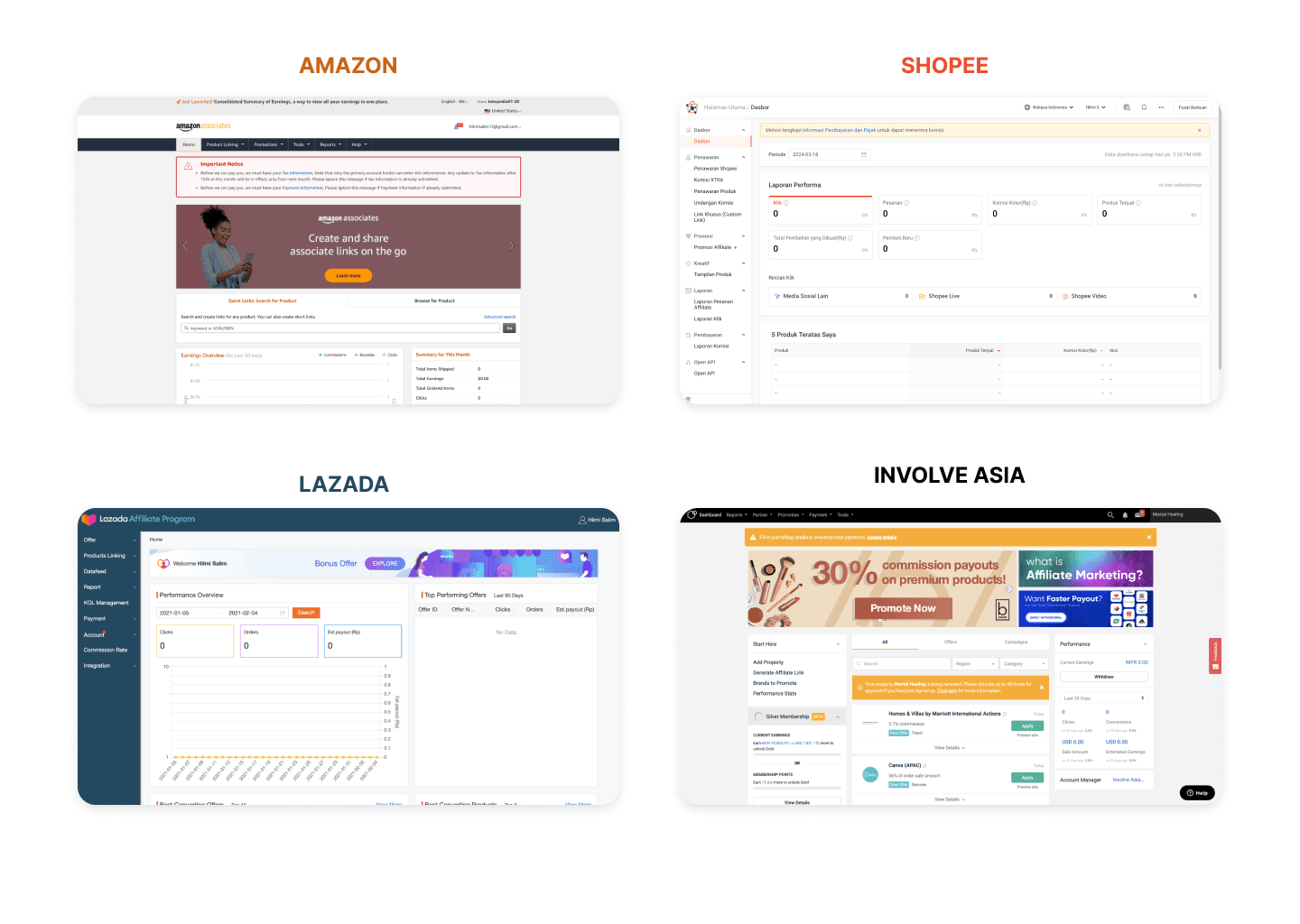
We only focus on that platform to refer to because from the Research team insights, the first three platforms are used by users, and the 4th one is the platform that is usually used by Indonesian influencers to manage their affiliate activity.
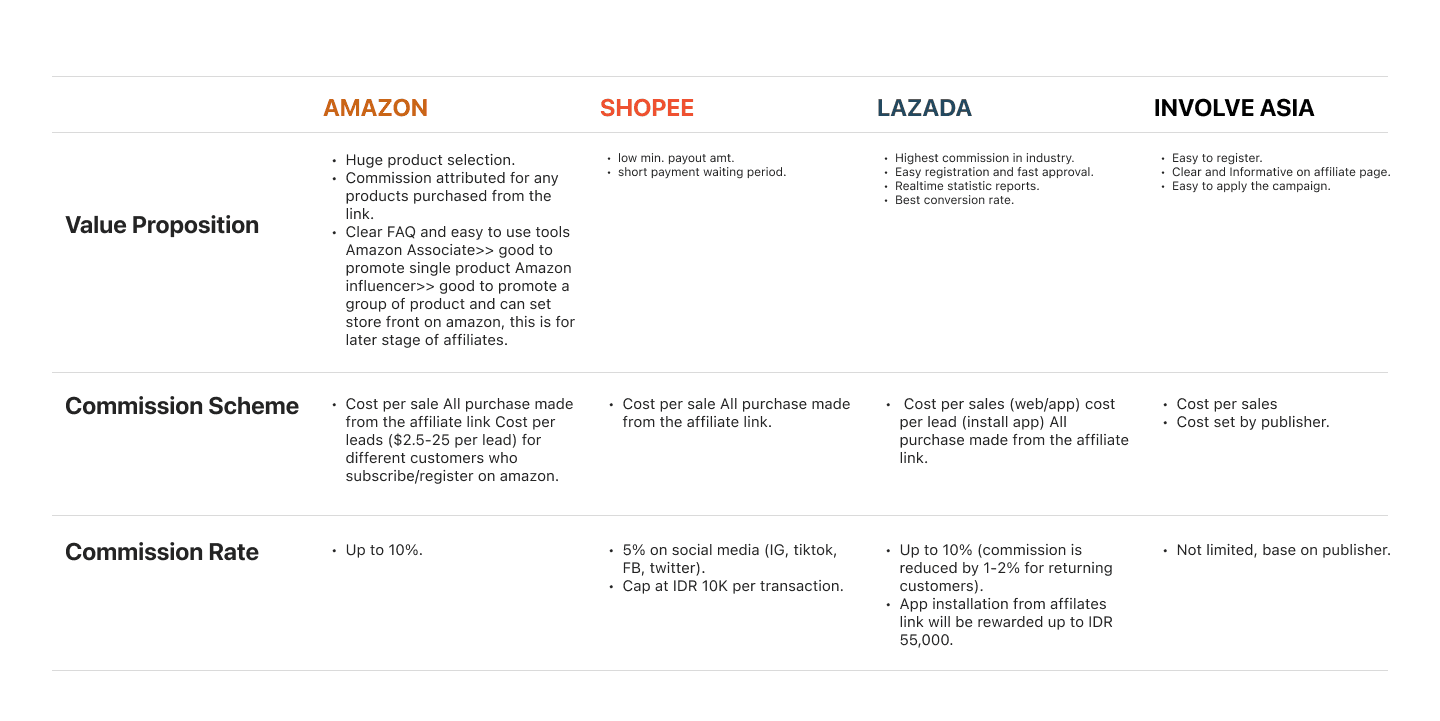
Here are the fundamental insights of a competitor’s products such as value proposition, commission scheme, and commission rate.
Qualitative research
I also did In-depth interviews with some middle and top influencers in Indonesia. I collaborated with the research team to conduct the session. Starting from creating a research plan, by questioning the background of why we did the research, what’s the objective of the research, and also creating a list of questions for the session.
To get more insights from different types of content creators, we divide into three categories;
The key points that we want to ask in this session include:
1. Understanding the user’s profile: To understand more about their daily routine as a content creator in general.
2. Business model and end-to-end journey: To understand how they monetize their traffic, for example; endorse, affiliate, etc.
3. Affiliate business model: Start bridging to ask more about Affiliate, and to understand if the participant is already familiar with affiliate or not.
4. Business process & tools: To understand how the content creator does their affiliate activity and what tools they use.
5. Expectation: To understand what are the expectations towards affiliate activity.
After the session finished, I mapped the insights on the online whiteboarding tools with the affinity diagram method, in which I categorized similar insights into one group. I divided the insights into 2 categories; Pain point and Insights. Also, I added the green stickies for the opportunity/idea generated after I got the insights.
Some of the pain points and insights I got from this research include:
Generate link:
Users feel uncomfortable use other platform because they need to generate link from desktop version, meanwhile they want to put on their social media that they create content using mobile phone.
Users feel confused how to get the affiliate link.
Users have to shorten link in other platform, because they get the full link from the platform.
Reporting:
Users need a clear traffic reporting from each shared affiliate link, because some of them still monitor manually from their third party such as linktree.
Sharing experience:
Users want to have seamless experience to share affiliate link directly from Product detail page.
Problem statement
How might we build a seamless affiliate feature, starting from registration, getting affiliate links, and ultimately earning income.
After deeply understanding the users and the competitor we came up with that problem statement.
Ideation Process
In addition, during the ideation process, I conducted a workshop to brainstorm ideas, define project scope, and get faster alignment with stakeholders. The workshop attendees included the AVP of Product, AVP of Product Design, PM Lead, Sr. Design Lead, and Design Lead, Head of Business. In this workshop session, I used the Hook Model Canvas framework;
First, I share the previous research insights so they can know what is happening in the field and have the same page about users’ POV.
Second, We separated into three groups that focus on each persona, and fill the hook model canvas based on their POV.
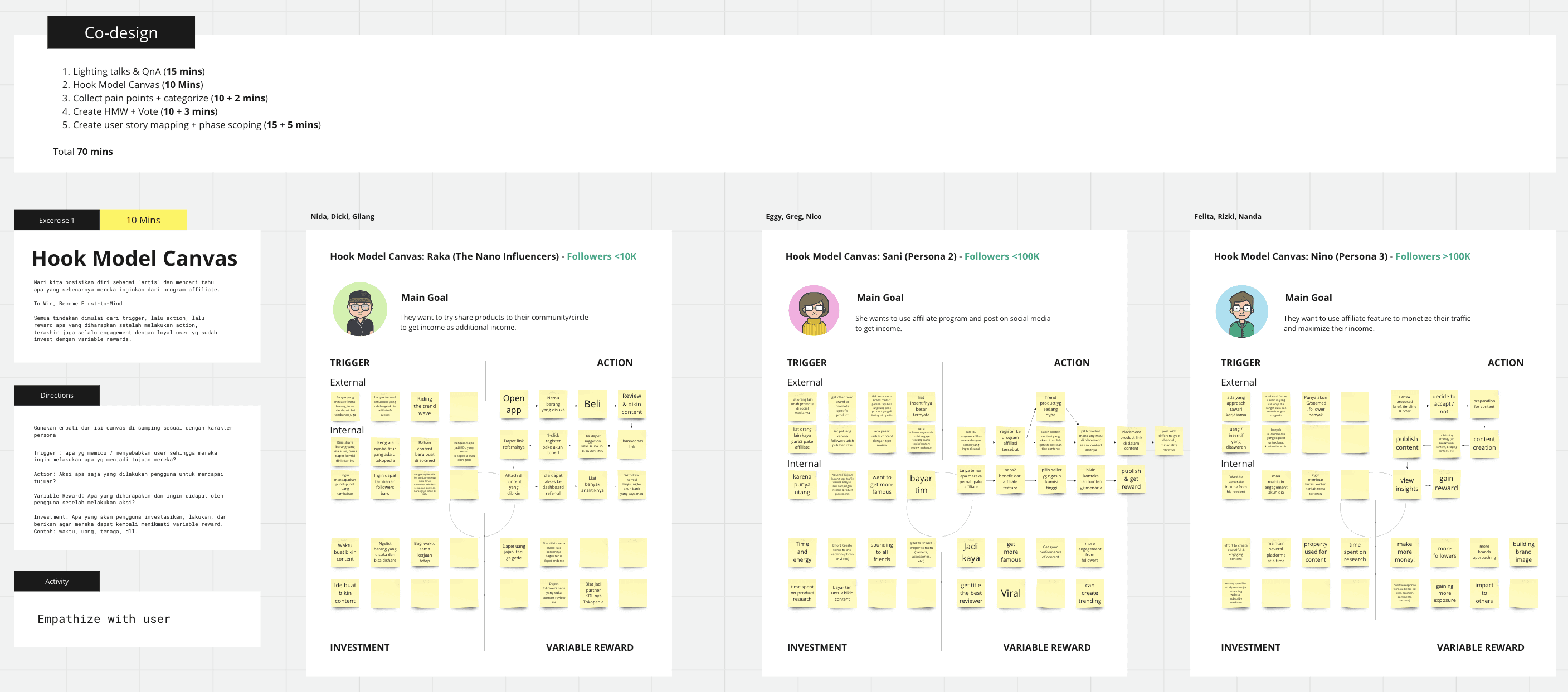
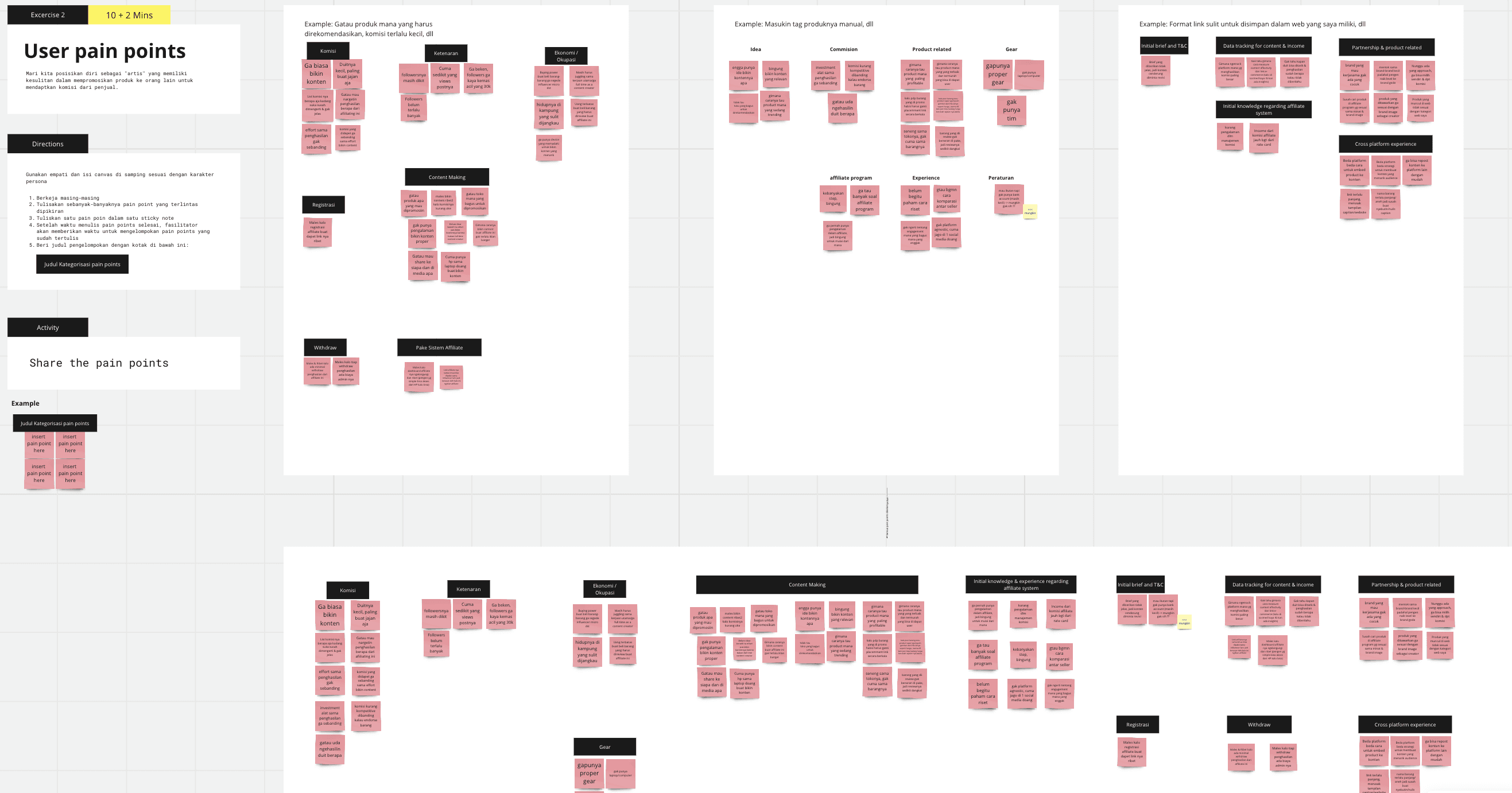
Third, I asked the participants to write possible pain points that could be felt by content creators, Also they can refer to my found insights. After we dump the pain points I group the sticky by similarity (Affinity).
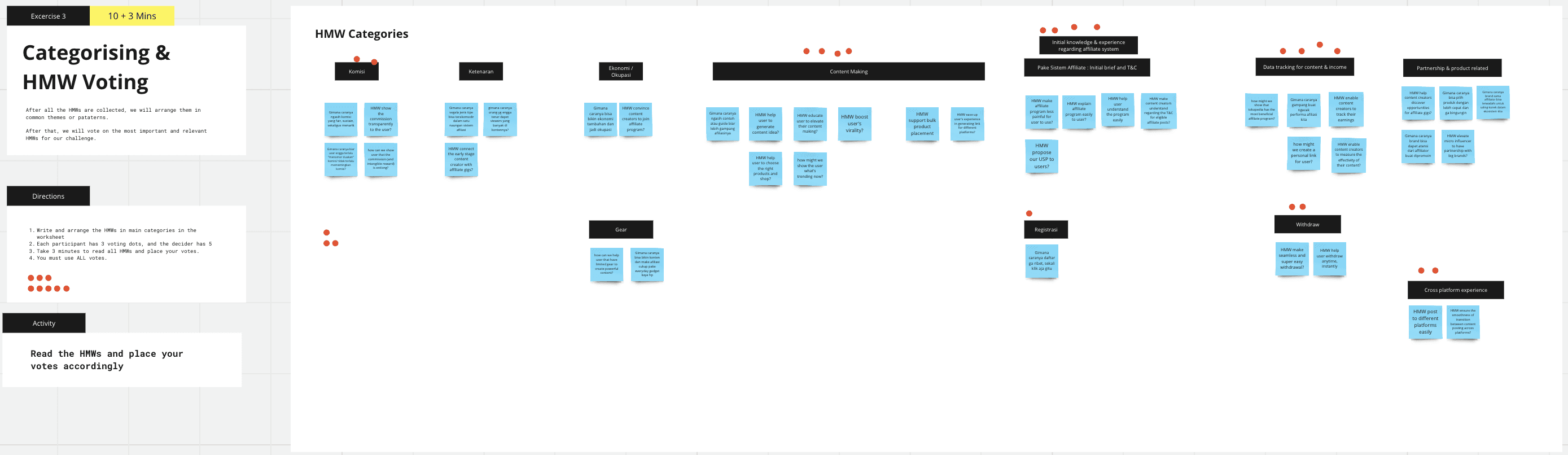
Fourth, We defined HMW based on the affinity to create triggered questions so we can explore possible ideas that could be implemented in our product. Also, we voted on the most urgent things so we could focus on that part in the first place.
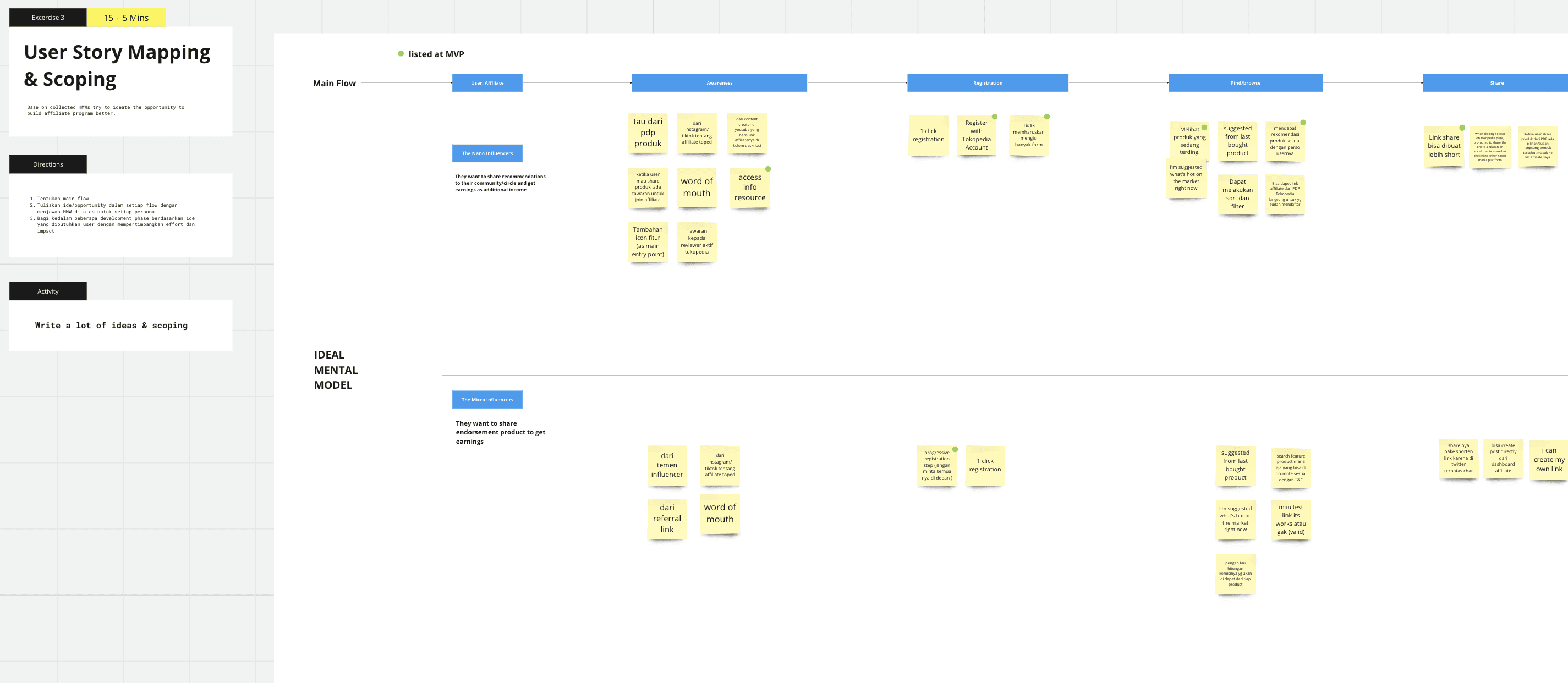
Fifth, User story mapping and scoping. I defined the main flow, so the participant can directly generate and put ideas on each journey based on the defined HMW in the previous stage. After that, we can discuss and map the generated ideas into phasing priority so we can know the scope in every development phase starting from Phase 1 (MVP), Phase 2, and Phase 3. This workshop output was a great foundation of affiliate products.
Design Exploration
After the ideation process, as usual, I created a user flow for each journey, information architecture, explored the design, did some design review with stakeholders, and did design iteration.
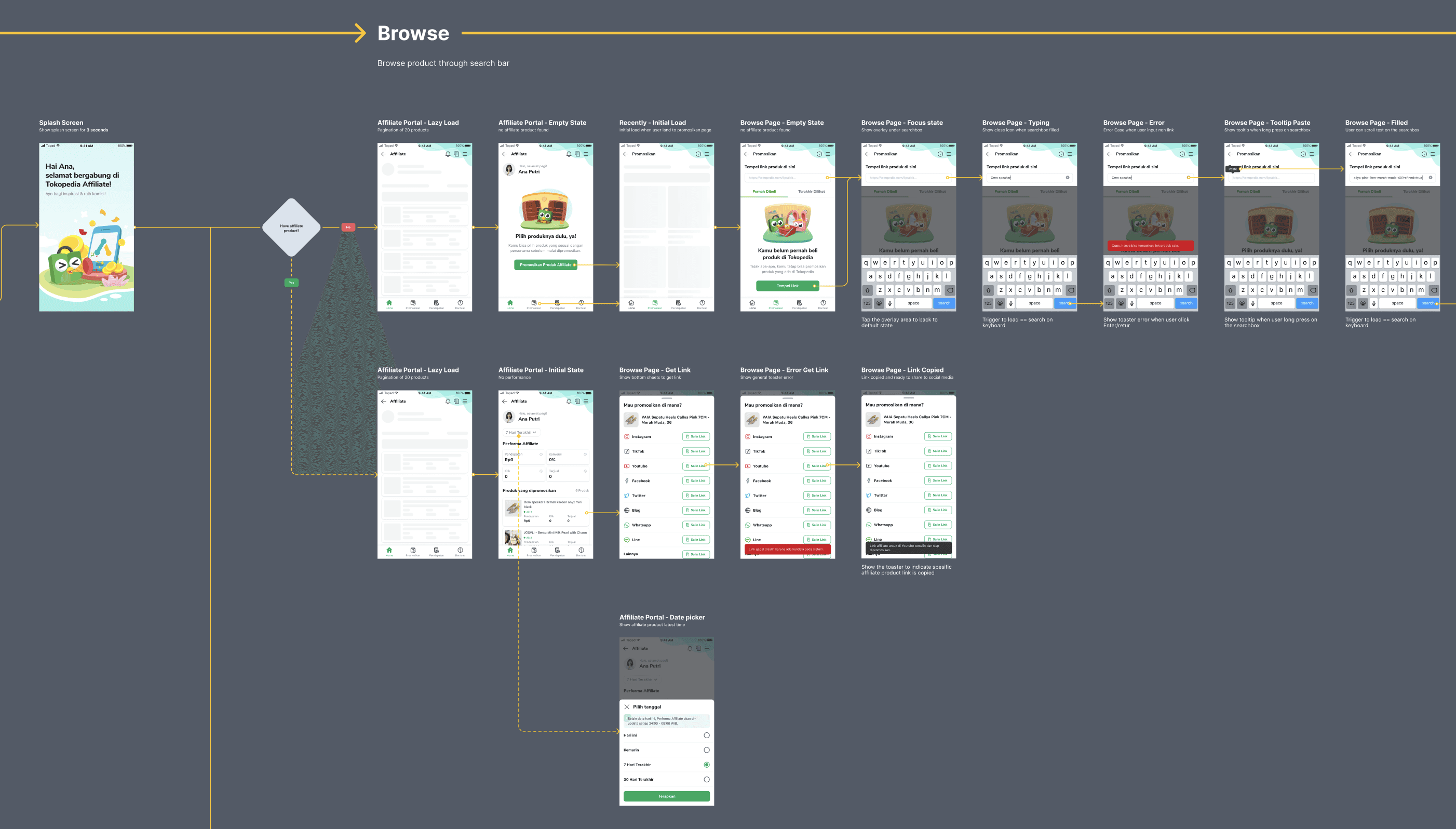
Here is a sneak peek of the wireflow that I created. *Full page of wireflow could be shared during a call/meeting session due to limited space if I attach it to this page.
Usability testing
Within a tight timeframe, I kept wanting to validate the design to some people who could be considered representative of our target users. We tested it to 5 people.
As usual, I created a prototype of the design and created a list of questions to conduct the session.
The key insights after conducting the design validation session include:
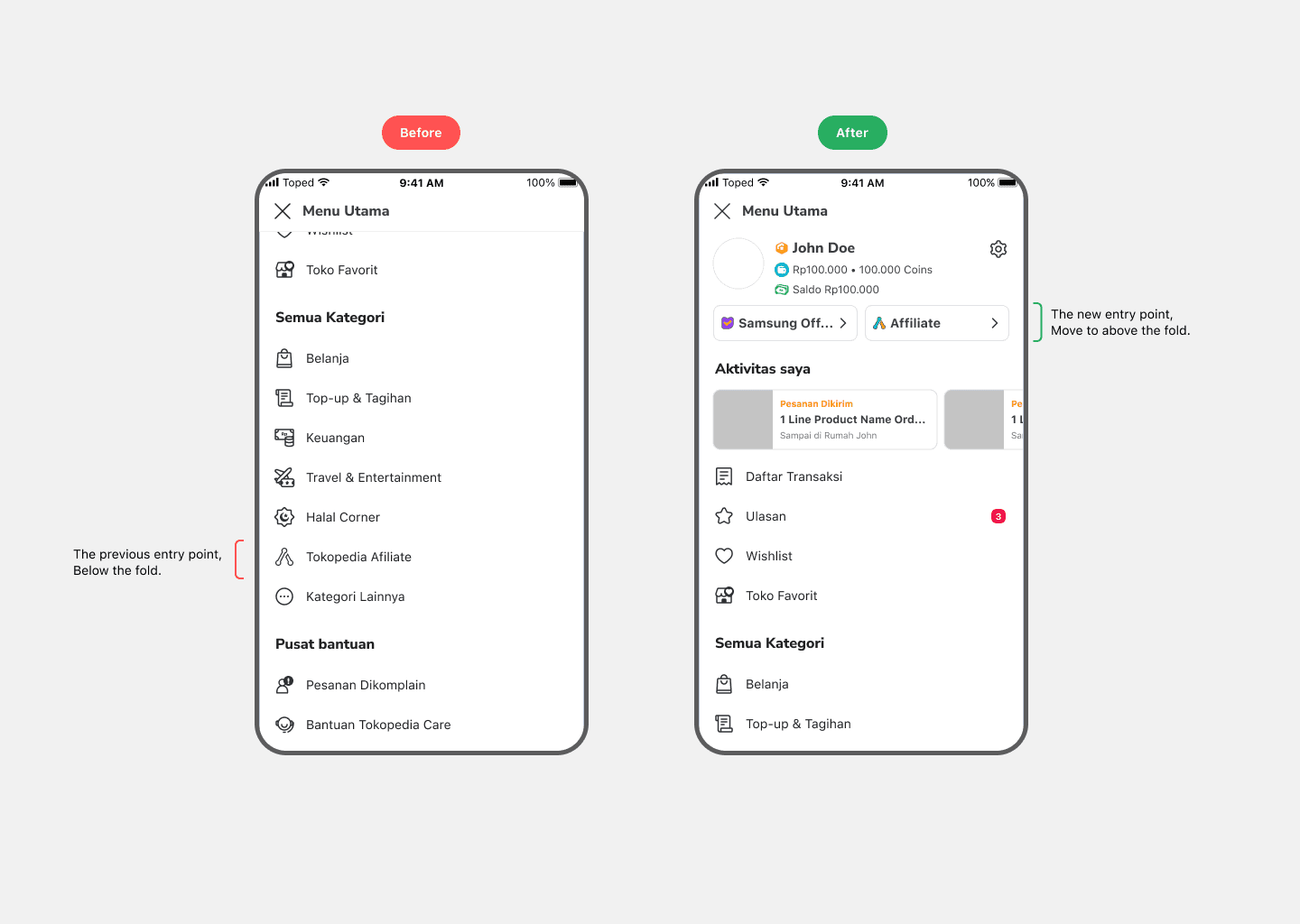
Problem: Users feel the entry points were not prominent for users so they hard to find entry points on the profile page. Design adjustment: I reiterated the entry point on the global profile page.
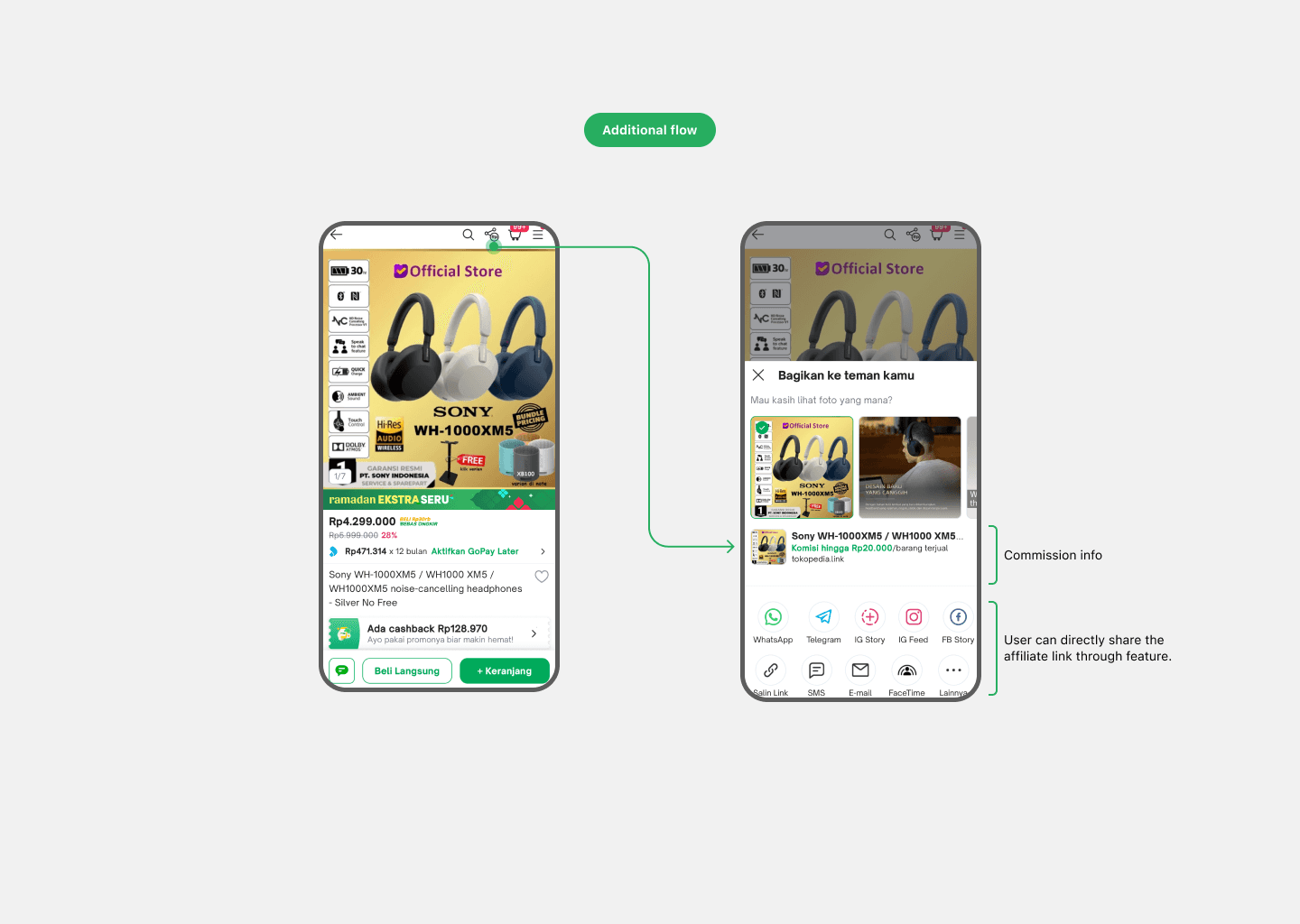
Insight: Users need to get the generated link directly from the product detail page when they tap the share button. Design adjustment: We provide entry point from product detail page, so user can directly get and share the affiliate link.
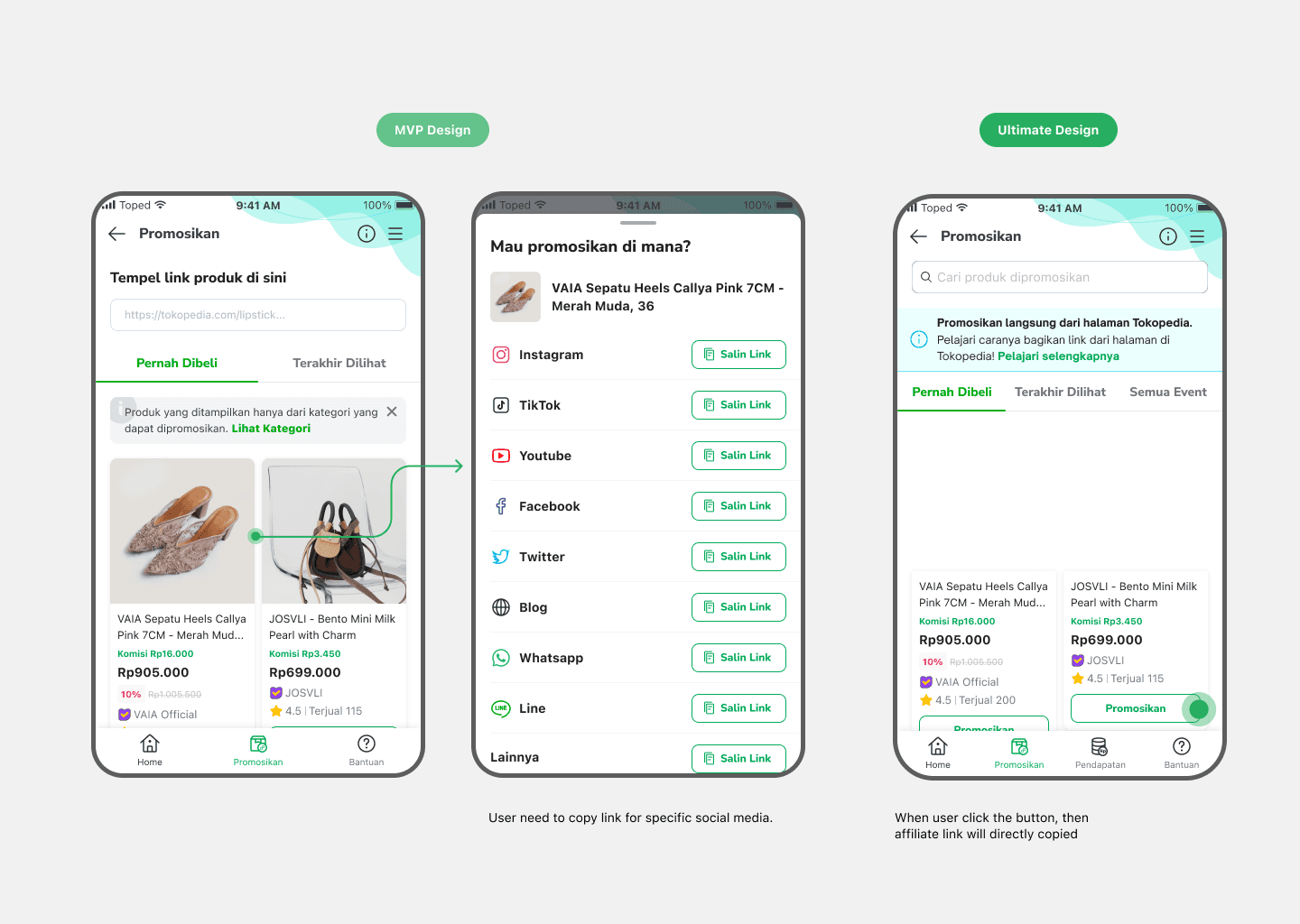
Problem: Users were a bit confused as to why there was a ‘Copy link’ button for each social media. Design adjustment: We kept the design with multiple buttons due to business needs and tech constraints to analyze which social media platform users shared the link. For the further design, we had considered using only one button to simplify the experience and ensure we could still monitor the traffic generated from the shared link by users.
Design Iteration/Final Design
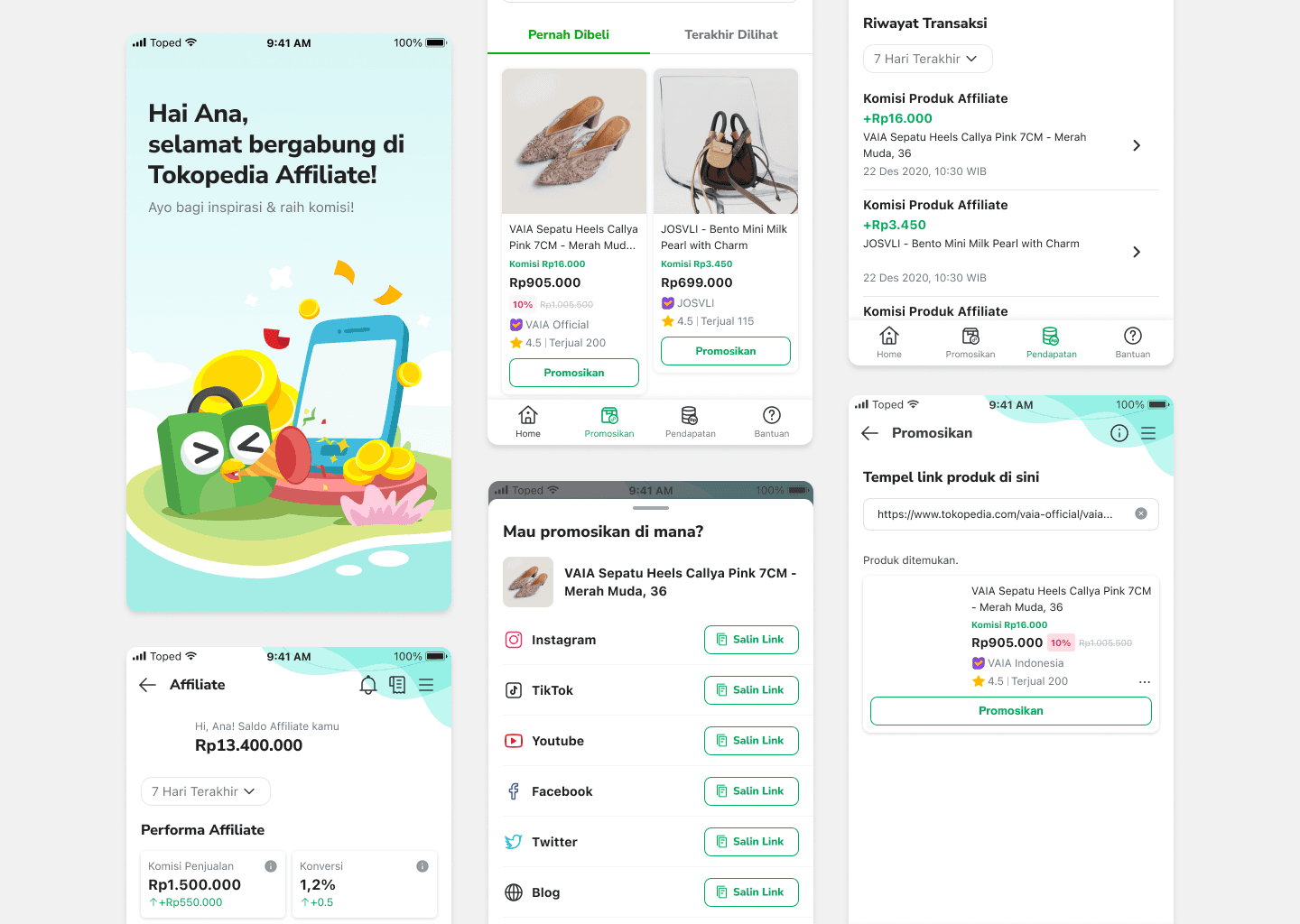
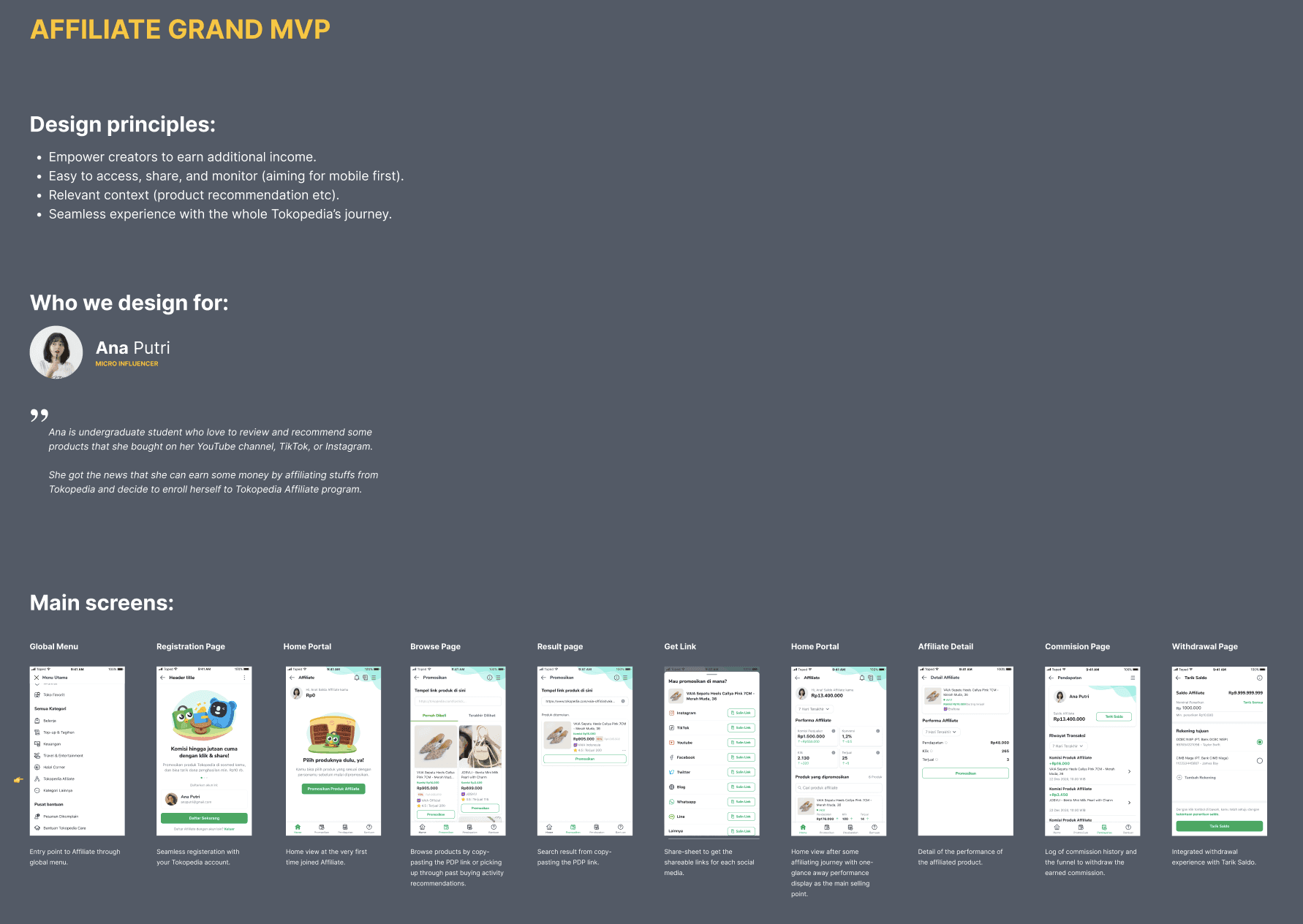
Finally, following the validation process and realignment with stakeholders, we got the final design for the MVP version. Here is the main screen:
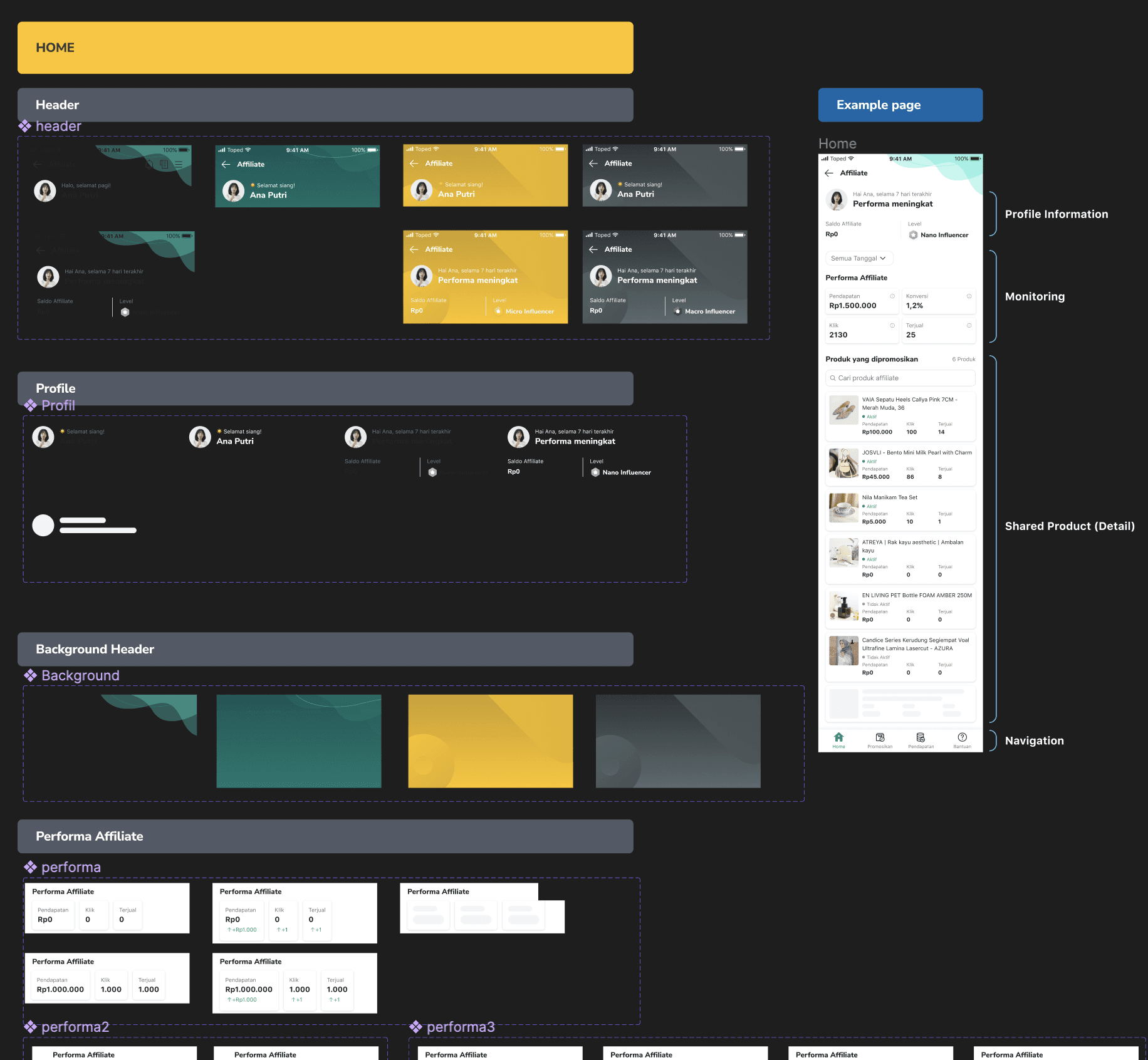
Other than that, I created reusable components for each page so we could maintain the design easily and faster. Here is a sneak peek of the reusable component I created.
Impact
After the launch of the Affiliate product, we witnessed a remarkable surge in traffic directed to Tokopedia through the links shared by our users. The traffic generated to the Product Detail page alone reached 2,268,901 visits. These numbers were achieved as per the target of our defined success metric.
Recognition
Thank you to all the teams that contribute to this project and made this project happen.
Dicki Dahrurozak as Product Design Manager, Ananda Nadya as Research Manager, Monika Halim as AVP of Design, Priscilla Anais as VP of Product, and any other teams that I cannot mention one by one.
Scope: Design from scratch, Competitive research, Ideation workshop, Design, Validation.
Role: Senior Product Designer
Background
There are approximately 160 million social media users across platforms in Indonesia (59% penetration according to the Global Web Index); they spend 3 hours a day scrolling through Instagram, Facebook, TikTok and Youtube. The adoption of social media led to the birth of not just passive viewers, but also content creators. They share their slice of life, point of view on current events, and also various experiences and recommendations, making social media as one of the most influential channels to form opinions and nudge decision-making. Some content creators are successful in gathering followers and monetizing their audience, whilst the remaining 95% are still struggling to establish themselves in the market.
This becomes an opportunity to increase Tokopedia’s share of voice on social media by creating a platform enabling content creators to promote millions of products on Tokopedia and monetize their influence in their circle.
Previously Tokopedia had already launched a similar product that we called By.me, but the performance was not good enough to maintain. So. we planned to change the concept of the product so that can be more useful for our users and gain traffic to Tokopedia.
Objective
Enable affiliates to promote Tokopedia Power Merchant & Official Store products with generated Tokopedia affiliate links placement in their content and monetize any successful traffic orders that come to Tokopedia from their affiliate link.
Success metrics
The main success metric of this product is the Increasing number of product visitors (traffic) to the product detail page from the affiliate link shared by the affiliate.
Our Target Users
We target people who want to monetize their traffic on social media and their influence power on their surrounding environment. We categorized it into 3 segments (Nano influencers, Micro influencers, Mid and above influencers):
Revisit Old Product Concept and Look at the new one
Effective in Q2 2021, we started to revisit our product, because previously we had already launched a similar product that we called By.me, but the performance was not good enough to maintain. Let’s see the main differences between the old and the new concepts below:
What is the difference between By.me and Affiliate Program?
By.me
While everyone could be an affiliate, users can only recommend products that opt-in merchants had selected and set commission. Merchant adoption became a bottleneck for overall product adoption.
Limited number of products (Supply constraint).
By.me content is only discoverable on users’ profiles in the Tokopedia app. Not available on other platforms, I have to know someone’s By.me ID to find the landing page.
Limited adoption. Post is mostly PDP images with captions from the user.
Tokopedia Affiliate
Hassle-free for the Seller to use the general commission table which applies to Products with PM & OS badges automatically eligible to be promoted
Have access to millions of products PM & OS to promote.
Affiliate-generated links can be used on widely accessible public media, such as social media (YouTube, Facebook, Instagram, Twitter, TikTok)
Multiple content formats and properties that allow different types of landing pages (PDP, SRP, CLP, Catalog or Discovery pages) thus make it easier for content creators to link products in a more granular manner.
After we had the same vision and clear concept to re-create this product, I as a designer started to do my design process.
Competitive and qualitative research
Competitive research
I did my competitive research to be more understand specifically the experience and the design of competitors. I did competitive research on several platforms including:
Amazon
Shopee
Lazada
Involve Asia
We only focus on that platform to refer to because from the Research team insights, the first three platforms are used by users, and the 4th one is the platform that is usually used by Indonesian influencers to manage their affiliate activity.
Here are the fundamental insights of a competitor’s products such as value proposition, commission scheme, and commission rate.
Qualitative research
I also did In-depth interviews with some middle and top influencers in Indonesia. I collaborated with the research team to conduct the session. Starting from creating a research plan, by questioning the background of why we did the research, what’s the objective of the research, and also creating a list of questions for the session.
To get more insights from different types of content creators, we divide into three categories;
The key points that we want to ask in this session include:
1. Understanding the user’s profile: To understand more about their daily routine as a content creator in general.
2. Business model and end-to-end journey: To understand how they monetize their traffic, for example; endorse, affiliate, etc.
3. Affiliate business model: Start bridging to ask more about Affiliate, and to understand if the participant is already familiar with affiliate or not.
4. Business process & tools: To understand how the content creator does their affiliate activity and what tools they use.
5. Expectation: To understand what are the expectations towards affiliate activity.
After the session finished, I mapped the insights on the online whiteboarding tools with the affinity diagram method, in which I categorized similar insights into one group. I divided the insights into 2 categories; Pain point and Insights. Also, I added the green stickies for the opportunity/idea generated after I got the insights.
Some of the pain points and insights I got from this research include:
Generate link:
Users feel uncomfortable use other platform because they need to generate link from desktop version, meanwhile they want to put on their social media that they create content using mobile phone.
Users feel confused how to get the affiliate link.
Users have to shorten link in other platform, because they get the full link from the platform.
Reporting:
Users need a clear traffic reporting from each shared affiliate link, because some of them still monitor manually from their third party such as linktree.
Sharing experience:
Users want to have seamless experience to share affiliate link directly from Product detail page.
Problem statement
How might we build a seamless affiliate feature, starting from registration, getting affiliate links, and ultimately earning income.
After deeply understanding the users and the competitor we came up with that problem statement.
Ideation Process
In addition, during the ideation process, I conducted a workshop to brainstorm ideas, define project scope, and get faster alignment with stakeholders. The workshop attendees included the AVP of Product, AVP of Product Design, PM Lead, Sr. Design Lead, and Design Lead, Head of Business. In this workshop session, I used the Hook Model Canvas framework;
First, I share the previous research insights so they can know what is happening in the field and have the same page about users’ POV.
Second, We separated into three groups that focus on each persona, and fill the hook model canvas based on their POV.
Third, I asked the participants to write possible pain points that could be felt by content creators, Also they can refer to my found insights. After we dump the pain points I group the sticky by similarity (Affinity).
Fourth, We defined HMW based on the affinity to create triggered questions so we can explore possible ideas that could be implemented in our product. Also, we voted on the most urgent things so we could focus on that part in the first place.
Fifth, User story mapping and scoping. I defined the main flow, so the participant can directly generate and put ideas on each journey based on the defined HMW in the previous stage. After that, we can discuss and map the generated ideas into phasing priority so we can know the scope in every development phase starting from Phase 1 (MVP), Phase 2, and Phase 3. This workshop output was a great foundation of affiliate products.
Design Exploration
After the ideation process, as usual, I created a user flow for each journey, information architecture, explored the design, did some design review with stakeholders, and did design iteration.
Here is a sneak peek of the wireflow that I created. *Full page of wireflow could be shared during a call/meeting session due to limited space if I attach it to this page.
Usability testing
Within a tight timeframe, I kept wanting to validate the design to some people who could be considered representative of our target users. We tested it to 5 people.
As usual, I created a prototype of the design and created a list of questions to conduct the session.
The key insights after conducting the design validation session include:
Problem: Users feel the entry points were not prominent for users so they hard to find entry points on the profile page. Design adjustment: I reiterated the entry point on the global profile page.
Insight: Users need to get the generated link directly from the product detail page when they tap the share button. Design adjustment: We provide entry point from product detail page, so user can directly get and share the affiliate link.
Problem: Users were a bit confused as to why there was a ‘Copy link’ button for each social media. Design adjustment: We kept the design with multiple buttons due to business needs and tech constraints to analyze which social media platform users shared the link. For the further design, we had considered using only one button to simplify the experience and ensure we could still monitor the traffic generated from the shared link by users.
Design Iteration/Final Design
Finally, following the validation process and realignment with stakeholders, we got the final design for the MVP version. Here is the main screen:
Other than that, I created reusable components for each page so we could maintain the design easily and faster. Here is a sneak peek of the reusable component I created.
Impact
After the launch of the Affiliate product, we witnessed a remarkable surge in traffic directed to Tokopedia through the links shared by our users. The traffic generated to the Product Detail page alone reached 2,268,901 visits. These numbers were achieved as per the target of our defined success metric.
Recognition
Thank you to all the teams that contribute to this project and made this project happen.
Dicki Dahrurozak as Product Design Manager, Ananda Nadya as Research Manager, Monika Halim as AVP of Design, Priscilla Anais as VP of Product, and any other teams that I cannot mention one by one.
Scope: Design from scratch, Competitive research, Ideation workshop, Design, Validation.
Role: Senior Product Designer
Background
There are approximately 160 million social media users across platforms in Indonesia (59% penetration according to the Global Web Index); they spend 3 hours a day scrolling through Instagram, Facebook, TikTok and Youtube. The adoption of social media led to the birth of not just passive viewers, but also content creators. They share their slice of life, point of view on current events, and also various experiences and recommendations, making social media as one of the most influential channels to form opinions and nudge decision-making. Some content creators are successful in gathering followers and monetizing their audience, whilst the remaining 95% are still struggling to establish themselves in the market.
This becomes an opportunity to increase Tokopedia’s share of voice on social media by creating a platform enabling content creators to promote millions of products on Tokopedia and monetize their influence in their circle.
Previously Tokopedia had already launched a similar product that we called By.me, but the performance was not good enough to maintain. So. we planned to change the concept of the product so that can be more useful for our users and gain traffic to Tokopedia.
Objective
Enable affiliates to promote Tokopedia Power Merchant & Official Store products with generated Tokopedia affiliate links placement in their content and monetize any successful traffic orders that come to Tokopedia from their affiliate link.
Success metrics
The main success metric of this product is the Increasing number of product visitors (traffic) to the product detail page from the affiliate link shared by the affiliate.
Our Target Users
We target people who want to monetize their traffic on social media and their influence power on their surrounding environment. We categorized it into 3 segments (Nano influencers, Micro influencers, Mid and above influencers):
Revisit Old Product Concept and Look at the new one
Effective in Q2 2021, we started to revisit our product, because previously we had already launched a similar product that we called By.me, but the performance was not good enough to maintain. Let’s see the main differences between the old and the new concepts below:
What is the difference between By.me and Affiliate Program?
By.me
While everyone could be an affiliate, users can only recommend products that opt-in merchants had selected and set commission. Merchant adoption became a bottleneck for overall product adoption.
Limited number of products (Supply constraint).
By.me content is only discoverable on users’ profiles in the Tokopedia app. Not available on other platforms, I have to know someone’s By.me ID to find the landing page.
Limited adoption. Post is mostly PDP images with captions from the user.
Tokopedia Affiliate
Hassle-free for the Seller to use the general commission table which applies to Products with PM & OS badges automatically eligible to be promoted
Have access to millions of products PM & OS to promote.
Affiliate-generated links can be used on widely accessible public media, such as social media (YouTube, Facebook, Instagram, Twitter, TikTok)
Multiple content formats and properties that allow different types of landing pages (PDP, SRP, CLP, Catalog or Discovery pages) thus make it easier for content creators to link products in a more granular manner.
After we had the same vision and clear concept to re-create this product, I as a designer started to do my design process.
Competitive and qualitative research
Competitive research
I did my competitive research to be more understand specifically the experience and the design of competitors. I did competitive research on several platforms including:
Amazon
Shopee
Lazada
Involve Asia
We only focus on that platform to refer to because from the Research team insights, the first three platforms are used by users, and the 4th one is the platform that is usually used by Indonesian influencers to manage their affiliate activity.
Here are the fundamental insights of a competitor’s products such as value proposition, commission scheme, and commission rate.
Qualitative research
I also did In-depth interviews with some middle and top influencers in Indonesia. I collaborated with the research team to conduct the session. Starting from creating a research plan, by questioning the background of why we did the research, what’s the objective of the research, and also creating a list of questions for the session.
To get more insights from different types of content creators, we divide into three categories;
The key points that we want to ask in this session include:
1. Understanding the user’s profile: To understand more about their daily routine as a content creator in general.
2. Business model and end-to-end journey: To understand how they monetize their traffic, for example; endorse, affiliate, etc.
3. Affiliate business model: Start bridging to ask more about Affiliate, and to understand if the participant is already familiar with affiliate or not.
4. Business process & tools: To understand how the content creator does their affiliate activity and what tools they use.
5. Expectation: To understand what are the expectations towards affiliate activity.
After the session finished, I mapped the insights on the online whiteboarding tools with the affinity diagram method, in which I categorized similar insights into one group. I divided the insights into 2 categories; Pain point and Insights. Also, I added the green stickies for the opportunity/idea generated after I got the insights.
Some of the pain points and insights I got from this research include:
Generate link:
Users feel uncomfortable use other platform because they need to generate link from desktop version, meanwhile they want to put on their social media that they create content using mobile phone.
Users feel confused how to get the affiliate link.
Users have to shorten link in other platform, because they get the full link from the platform.
Reporting:
Users need a clear traffic reporting from each shared affiliate link, because some of them still monitor manually from their third party such as linktree.
Sharing experience:
Users want to have seamless experience to share affiliate link directly from Product detail page.
Problem statement
How might we build a seamless affiliate feature, starting from registration, getting affiliate links, and ultimately earning income.
After deeply understanding the users and the competitor we came up with that problem statement.
Ideation Process
In addition, during the ideation process, I conducted a workshop to brainstorm ideas, define project scope, and get faster alignment with stakeholders. The workshop attendees included the AVP of Product, AVP of Product Design, PM Lead, Sr. Design Lead, and Design Lead, Head of Business. In this workshop session, I used the Hook Model Canvas framework;
First, I share the previous research insights so they can know what is happening in the field and have the same page about users’ POV.
Second, We separated into three groups that focus on each persona, and fill the hook model canvas based on their POV.
Third, I asked the participants to write possible pain points that could be felt by content creators, Also they can refer to my found insights. After we dump the pain points I group the sticky by similarity (Affinity).
Fourth, We defined HMW based on the affinity to create triggered questions so we can explore possible ideas that could be implemented in our product. Also, we voted on the most urgent things so we could focus on that part in the first place.
Fifth, User story mapping and scoping. I defined the main flow, so the participant can directly generate and put ideas on each journey based on the defined HMW in the previous stage. After that, we can discuss and map the generated ideas into phasing priority so we can know the scope in every development phase starting from Phase 1 (MVP), Phase 2, and Phase 3. This workshop output was a great foundation of affiliate products.
Design Exploration
After the ideation process, as usual, I created a user flow for each journey, information architecture, explored the design, did some design review with stakeholders, and did design iteration.
Here is a sneak peek of the wireflow that I created. *Full page of wireflow could be shared during a call/meeting session due to limited space if I attach it to this page.
Usability testing
Within a tight timeframe, I kept wanting to validate the design to some people who could be considered representative of our target users. We tested it to 5 people.
As usual, I created a prototype of the design and created a list of questions to conduct the session.
The key insights after conducting the design validation session include:
Problem: Users feel the entry points were not prominent for users so they hard to find entry points on the profile page. Design adjustment: I reiterated the entry point on the global profile page.
Insight: Users need to get the generated link directly from the product detail page when they tap the share button. Design adjustment: We provide entry point from product detail page, so user can directly get and share the affiliate link.
Problem: Users were a bit confused as to why there was a ‘Copy link’ button for each social media. Design adjustment: We kept the design with multiple buttons due to business needs and tech constraints to analyze which social media platform users shared the link. For the further design, we had considered using only one button to simplify the experience and ensure we could still monitor the traffic generated from the shared link by users.
Design Iteration/Final Design
Finally, following the validation process and realignment with stakeholders, we got the final design for the MVP version. Here is the main screen:
Other than that, I created reusable components for each page so we could maintain the design easily and faster. Here is a sneak peek of the reusable component I created.
Impact
After the launch of the Affiliate product, we witnessed a remarkable surge in traffic directed to Tokopedia through the links shared by our users. The traffic generated to the Product Detail page alone reached 2,268,901 visits. These numbers were achieved as per the target of our defined success metric.
Recognition
Thank you to all the teams that contribute to this project and made this project happen.
Dicki Dahrurozak as Product Design Manager, Ananda Nadya as Research Manager, Monika Halim as AVP of Design, Priscilla Anais as VP of Product, and any other teams that I cannot mention one by one.